Why Am I Afraid of Success
Most people are comfortable admitting they're afraid of failure. It's socially acceptable, even relatable. What far fewer people recognize — or are willing to name out loud — is that they may also be afraid of success. And of the two, fear of success is often the more destructive, precisely because it goes unrecognized. It doesn't announce itself. It hides behind procrastination, self-sabotage, sudden losses of motivation, and mysterious "bad luck" that seems to strike right when things start going well.
If you've ever pulled back the moment an opportunity started to materialize, quit a project just before completing it, or watched yourself do something that quietly torpedoed a promotion, a relationship, or a goal you claimed to want — you've likely met your own fear of success without realizing it. The good news is that this fear is not a personality flaw, a discipline problem, or evidence that you don't "really" want the thing you say you want. It's the predictable output of specific beliefs operating underneath your awareness. Once you understand how those beliefs work, the fear stops feeling like a mystery — and becomes something you can actually address.
Fear of Success Doesn't Look Like Fear
The first thing to understand is that fear of success rarely feels like fear. When people imagine what fear looks like, they picture the pounding heart, the sweaty palms, the racing thoughts of an obvious threat. Fear of success looks nothing like that. It's quiet. It's subtle. Most of the time, it disguises itself as one of the following:
Loss of motivation. You were fired up about the goal for weeks or months. Then, seemingly overnight, the enthusiasm evaporated. You still know the goal is important. You just... don't feel like working on it anymore. The energy is gone.
Sudden distraction. Right as things start to take off, an urgent life issue appears out of nowhere — a health scare, a family drama, a financial emergency, a fight with a partner — that pulls all your attention away from the goal. When you look back later, you may notice these "crises" have a strange habit of appearing at inflection points.
Perfectionism paralysis. You can't finish the thing. It's never quite ready. There's one more revision, one more improvement, one more piece of research to do before you can launch, ship, submit, or announce. The bar keeps moving.
Self-sabotage disguised as reasonable choices. You skip the important meeting because you're "too tired." You don't apply for the opportunity because "it probably wouldn't work out anyway." You pass on the introduction because "the timing isn't right." Each individual decision looks defensible. The pattern tells a different story.
Regression to old habits. You lost the weight and then, over a period of months, quietly regained it. You built the savings and then made a series of purchases that drained them. You improved the relationship and then picked a fight that ended it. Each individual move seems disconnected. Together, they restore the previous baseline.
The through-line in all of these patterns is not weakness. It's not laziness. It's not a lack of discipline. It's a subconscious system operating exactly as designed — moving you back toward what it recognizes as familiar and safe, even when what's familiar isn't what's good for you.
The Subconscious Doesn't Care What You Want
To understand why fear of success operates the way it does, you have to understand something about the subconscious mind that most people never fully absorb: your subconscious is not on your team in the way you think it is.
Research in neuroscience suggests that roughly 90% or more of your daily thoughts, decisions, and behaviors are governed by your subconscious, running automatically in the background. When you drive a familiar route home and can't remember the last ten minutes, that's your subconscious. When you reach for your phone without deciding to, that's your subconscious. When you feel an immediate, unexplainable resistance to an opportunity that logically looks great, that's your subconscious too.
The subconscious does one thing extremely well: it executes on the beliefs that are stored in it, whatever those beliefs happen to be. It doesn't evaluate whether those beliefs serve you. It doesn't check whether they're accurate. It doesn't care whether they align with your conscious goals. It simply defends and enacts them, day after day, decision after decision, without asking your permission.
This is a critical point. The subconscious will translate a thought driven by fear into reality just as readily as it will translate a thought driven by courage. It works with whatever material is fed into it. If the material stored in your subconscious includes the belief that success is dangerous, that visible achievement invites punishment, or that you don't deserve good things — then the subconscious will faithfully execute on those beliefs, using the same efficiency and automaticity it uses to help you brush your teeth or drive to work.
This is why willpower alone almost never overcomes fear of success. Willpower is a conscious tool. It operates in the 10% of your mind that is aware and deliberate. Fear of success operates in the 90% that isn't. You can spend the 10% of your day fighting for the goal, and the 90% will still quietly walk you back to where the subconscious believes you belong. It's not a fair fight, and it was never meant to be one.
Where Fear of Success Actually Comes From
Fear of success isn't installed at birth. It's absorbed, usually early, from patterns of experience that the developing mind interpreted as important. Understanding the common sources is often the first step in identifying which ones may be running in you.
Success That Was Punished or Envied in Your Environment
If you grew up in an environment where someone who succeeded was treated with resentment, jealousy, exclusion, or ridicule — whether by family members, peers, or the broader community — the mind absorbs a simple equation: success equals loss of belonging. A child who watches their high-achieving sibling get labeled "arrogant" or "showing off" learns something. A child who sees a parent get shut out of the family for being financially successful learns something else. A child who is teased at school for good grades, athletic performance, or attention from authority figures learns yet another version of the same lesson.
None of this is consciously reasoned. The child doesn't sit down and calculate the tradeoff. The mind simply files the pattern away: visible success is dangerous, and staying at or near the level of the group is safe. Decades later, that filing shows up as an unexplained resistance to being visible, to charging what you're worth, to accepting recognition, or to allowing yourself to move too far beyond the achievement level of the people you grew up with.
Modeling from Caregivers Who Didn't Pursue Their Own Success
Children absorb what caregivers do far more than what caregivers say. A parent who talks constantly about dreams they never pursued teaches the child two things: that dreams matter, and that dreams are things you don't actually chase. A parent who starts businesses that fail and speaks of the process as a source of shame teaches the child that ambition is followed by humiliation. A parent who reaches a certain level of achievement and then plateaus, sometimes for reasons the parent can't articulate, teaches the child that this level is the appropriate ceiling for people like them.
Consider two young women, both raised by single mothers, both offered the same entry-level opportunity at a local news organization. The first was raised by a mother who worked hard at a job she disliked and compensated for her unhappiness with spending. That daughter absorbed the belief that financial security matters more than fulfillment. She turned down the news job for a better-paying position in an unrelated field — and lived a comfortable but unfulfilled life. The second was raised by a mother who pursued her dream of teaching and spoke frequently of how much she loved it, despite having to budget carefully. That daughter absorbed the belief that pursuing meaningful work matters more than pursuing money. She took the news job, worked her way up, and became a successful journalist who eventually achieved financial security too.
Same facts. Same opportunity. Vastly different outcomes. The variable wasn't intelligence, talent, or discipline. It was the belief each woman had absorbed about what success is even supposed to look like.
Conditional Love Tied to Achievement
Some children learn early that love and approval are conditional on performance. When the grades were high, the affection flowed. When they slipped, the warmth withdrew. This creates a strange and enduring double-bind in the adult mind: achievement becomes both desperately sought and quietly feared, because success under those conditions is not a source of joy — it's a temporary reprieve from the anxiety of losing love. And any temporary reprieve, by definition, is followed by the anxiety of losing it again.
Adults who grew up under conditional love often describe an odd hollowness after achieving goals they thought would feel triumphant. They may also describe a habit of moving the goalposts — succeeding, then immediately deciding the success didn't count and setting a new, higher bar. The subconscious is trying to protect them from the crash that historically followed achievement.
Beliefs About Deservingness
Perhaps the most common source of fear of success is a straightforward core belief that runs something like: "I don't deserve good things." This belief can form in countless ways — from being told directly, from being treated as though the child were a burden, from receiving affection that was framed as a favor rather than a right, or from a thousand small interactions that added up to a single conclusion in the child's mind: I am not the kind of person for whom good things happen.
Consider the case of a small business owner who, for years, would begin to make significant money and then pull back, essentially stopping work for weeks at a time until he ran through what he had earned. Then the cycle would start again. On the surface, this looked like poor discipline or bad business judgment. In reality, when he traced the pattern back, he discovered a childhood in which his mother — a compulsive shopper who had been placed on a strict budget by his father — would buy him small toys and gifts, but require him to hide them from his father. Each of those gifts came with shame attached. The message he absorbed was that he didn't deserve the things he was receiving, and that receiving good things came with the requirement to hide them.
As an adult, every time he began to earn beyond his subconscious's tolerance level, that childhood belief activated. He didn't experience it as a belief. He experienced it as a vague discomfort, a loss of motivation, a sudden desire to take time off, a series of small decisions that added up to walking away from the money. It was, in effect, his subconscious asking him to hide the toys again.
Once he identified the actual belief and replaced it, he set a financial goal he had never been able to hit — and achieved it in under a year. He described it as "just flowing," which is what it feels like when the subconscious and the conscious are finally aligned instead of at war.
Why Fear of Success Is So Hard to See in Yourself
If fear of success is this common, why do so few people recognize it in themselves? Several reasons.
It doesn't feel like fear — it feels like reasoning. When the subconscious wants you to pull back, it doesn't send a warning that says "I am afraid of success." It sends a thought that says "this timing isn't right," or "I need more experience first," or "this opportunity has too many risks." The thought feels rational because you generated it. It is often only in retrospect, sometimes years later, that the pattern becomes visible.
It contradicts your self-image. No one wants to believe they're the person who is sabotaging their own life. It's much more comfortable to believe the world is against you, the timing was off, or the opportunity wasn't as good as it seemed. Admitting fear of success requires accepting a version of yourself that doesn't fit the story you've been telling.
The subconscious protects itself. The mind will actively resist information that threatens its existing beliefs, including beliefs about itself. This is a well-documented phenomenon in psychology. When you get close to identifying a belief that has been running your life, you may experience unusual resistance — sudden fatigue, irritability, a strong urge to change the subject, or the appearance of a distraction that pulls you away from the reflection.
The pattern gets normalized. If you've been doing something for decades, it stops looking like a pattern and starts looking like who you are. "I always self-sabotage" becomes an identity statement instead of an observation about a repeatable pattern with an identifiable cause.
How to Start Identifying Fear of Success in Yourself
Because fear of success operates below awareness, the first step in addressing it is not to try to overcome it — that's fighting the 90% with the 10% again. The first step is to make the invisible visible. Several practices help.
Look at your patterns, not your intentions. Your intentions are what your conscious mind wants. Your patterns are what your subconscious actually produces. If there's a persistent gap between the two, that gap is where the belief lives. Look at the last three or four times you got close to a meaningful success. What happened? Did you finish? Did you pull back? Did something come up? Did you lose interest? Did you shift your energy to something else at a critical moment? The pattern will be visible if you're willing to see it.
Ask the reframe question. Instead of asking "what's wrong with me," ask: "What would I have to believe about myself, or about success, for this pattern to make sense?" This is a much more productive question because it shifts you out of self-blame and into detective mode. If you consistently pull back right before completing a project, what would you have to believe for that behavior to be logical? Some possibilities: "If I finish it and it fails, I'll be humiliated." "If I finish it and it succeeds, my life will change in ways I can't control." "People will expect more of me next time." "I'll be exposed as a fraud." Any of these, held subconsciously, would produce exactly the behavior you're seeing.
Notice your resistance to reflection. As you sit with these questions, notice what happens in your body and mind. Do you feel the urge to change the subject? Do you suddenly remember something else you need to do? Do you feel tired? These reactions are useful data. The subconscious tends to defend the beliefs that are most central to it — and the strongest resistance often surrounds the most important insights.
Look at what your caregivers modeled. Not what they said. What they did. What did they teach you, by example, about pursuing dreams, about earning money, about being visible, about accepting recognition, about being different from the people around you? These early lessons often form the operating system that governs your reaction to success as an adult.
Look at what happened when you succeeded as a child. Were you celebrated? Ignored? Envied? Punished? Treated differently? Made to feel bad for the effect your success had on others? These early experiences left an imprint, and that imprint is still influencing how your subconscious interprets success today.
What Actually Works to Address Fear of Success
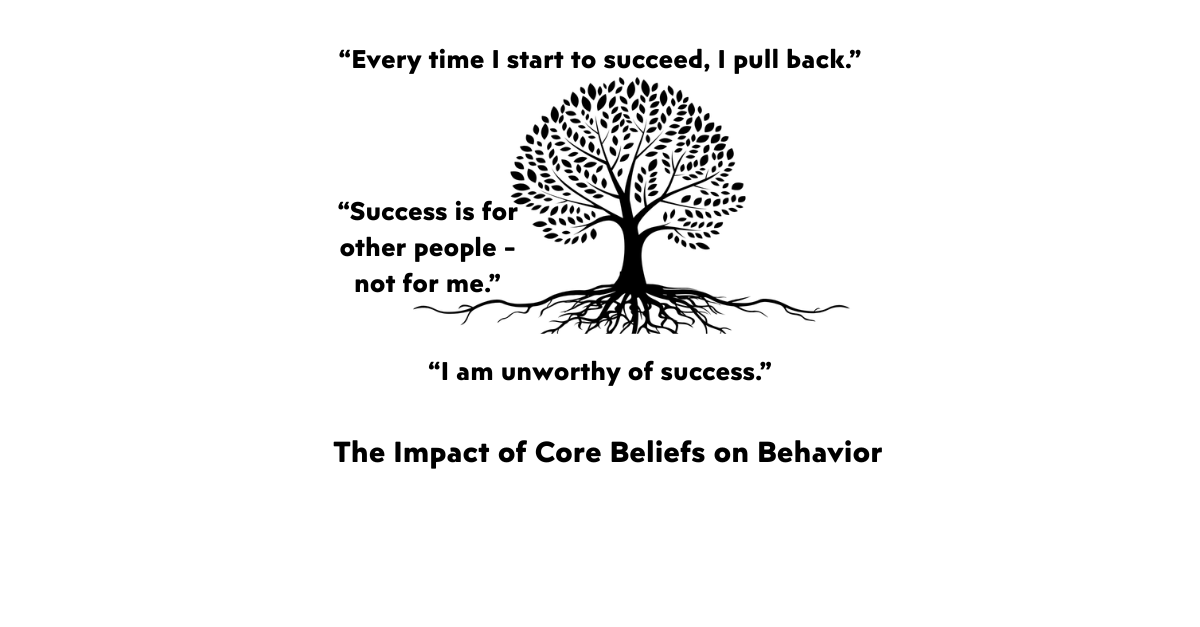
Understanding where fear of success comes from is only half the work. The other half is doing something about it — and the something has to happen at the belief level, not the behavior level. Trying to fix fear of success by fixing the behavior is like trying to change what a tree looks like by pulling off individual leaves. New leaves will grow that look exactly like the old ones, because the tree itself hasn't changed.
Belief change is a different process from behavior change, and it operates by different rules. Three principles are worth understanding.
Beliefs are replaced, not defeated. You cannot argue a subconscious belief out of existence. You cannot logic it into submission. You cannot shame it into leaving. What you can do is identify the belief clearly, articulate its opposite as a new belief, and give the subconscious enough consistent exposure to the new belief that it accepts it as the operating truth. This is why "just think positive" doesn't work — it treats the surface without addressing the root. It's also why identifying the actual belief matters more than the technique you use to replace it. If you're aiming at the wrong target, no technique will help.
Core beliefs need to be addressed before specific beliefs will stick. If your core belief is "I am unworthy of success," you can repeat "I am a successful entrepreneur" every morning for a year and get nowhere. The specific belief conflicts with the core belief, and the core belief wins. This is why so many people find that affirmations don't work — not because affirmations are useless, but because the affirmations are pointed at the wrong level of the belief system. Core beliefs are the roots. Specific beliefs are the trunk. Behaviors are the branches. Fixing branches while ignoring roots is a losing game.
The subconscious accepts new beliefs through repetition and emotion, not logic. The same mechanism that installed the original belief — repeated exposure, often paired with emotion, over time — is the mechanism required to install a new one. This is neither fast nor magical. It's a process, and it works when it's done consistently. Most people give up on belief change too soon because they expect immediate results, and the subconscious does not operate on an immediate-results timeline.
The Reframe That Changes Everything
If there's one shift worth internalizing from all of this, it's the reframe that fear of success isn't a personal failing. It's an artifact — a leftover — of beliefs you didn't choose and mostly didn't know you had.
The person who keeps sabotaging their own business isn't undisciplined. They're running a childhood program that says success is dangerous, or that they don't deserve it, or that visible achievement will cost them something they need more than they need the achievement itself. The person who can't finish the book isn't lazy. The person who quits the diet at month three isn't weak. The person who talks themselves out of every opportunity isn't stupid. They are, in each case, executing on beliefs that were installed a long time ago, often before they were old enough to question them.
This reframe matters because the way most people talk about fear of success — as a character flaw, as evidence of weakness, as something to be ashamed of — actively makes it harder to address. Shame drives the belief deeper. It confirms the underlying story that there's something fundamentally wrong with the person. It makes the reflection required to identify the belief feel dangerous, so the person avoids the reflection, and the belief keeps running.
The alternative is to treat fear of success the way you'd treat any other diagnostic finding. It's information. It's telling you something specific about what beliefs are stored in your subconscious. It's pointing directly at the material that needs to be worked with. Once you look at it that way, fear of success stops being a source of shame and becomes a source of leverage — because the beliefs behind it are, in fact, changeable.
A Final Note
The fear of success that has been running your life is not proof that you don't want success. It's proof that some part of you learned, at some point, that success comes with a cost. That learning was accurate for the environment you were in when it happened. It is no longer accurate for the life you're trying to build now. And it is not permanent.
The work is not to fight the fear. The work is to identify the belief underneath it, articulate what you would need to believe instead, and give the subconscious enough exposure to the new belief that it accepts it. When that shift happens, the fear doesn't disappear so much as become irrelevant. The pattern breaks. The subconscious stops pulling you back to the old baseline, because the old baseline is no longer what it recognizes as normal.
The people you know who "make it look easy" are not more talented, more disciplined, or luckier than you. In most cases, they simply hold different beliefs about what they deserve, what success requires, and what happens after they achieve it. Those beliefs were absorbed the same way yours were — through repetition, environment, and emotion. And beliefs that were absorbed can be absorbed differently.
Fear of success is not the problem. It's the symptom. The problem — and the leverage point — is one level down. That's where the work happens. And that's where it starts to actually change.